Key Takeaways
In this article I will cover:
- The 46% Pass Rate: Briefing has a lower pass rate than Main Board. An honest look at the numbers within the full selection funnel.
- The Four Categories Explained: A breakdown of what Category 1 to 4 results actually mean for your career and your immediate timeline.
- The 6 Core Assessments: What to expect during the 24-hour assessment, from psychometric testing to the leaderless outdoor tasks.
- A Diagnostic, Not Just a Test: Understanding the dual purpose of Briefing as both a competitive selection filter and a developmental tutorial.
- Feedback as a Roadmap: Why the expert development points you receive at Westbury give you a roadmap for your Main Board preparation.
You have passed your Officer Interview, your medical clearance has come through, and you are about to arrive at Westbury for Briefing. Over the next two days, you will face your first real assessment. By the time you leave, you will know whether you can proceed directly to Main Board, or whether the Army wants you to develop further before taking that step.
In 2024, just 46% of candidates received a Category 1, the result that allows you to proceed directly to Main Board. The remaining 54% either faced a delay of several months, were told they would likely struggle at Main Board, or were not recommended to continue with officer selection at all.
This is where the process becomes serious. The Officer Interview has a high pass rate and requires limited preparation. Briefing is different. It is the first point at which a significant number of candidates are filtered out or delayed, and it is the first assessment where thorough preparation makes a measurable difference.
In this guide, I will explain exactly what Briefing involves, how the category system works, what each assessment requires, and how to give yourself the best possible chance of receiving a Category 1.
What is Briefing?
Briefing is a two-day assessment held at the Army Officer Selection Board centre in Westbury. It will likely be the first time you feel under real pressure during the AOSB process, and the Army's first proper look at you.
Briefing serves two purposes, and it is important to understand both. The first is to prepare you for Main Board. You will be introduced to the assessments you will face at the next stage of AOSB, and receive advice on how to approach them.
The second purpose, and the one that is most immediately relevant to you, is to identify candidates who are not yet ready for Main Board. While the assessors will come across as supportive relative to Main Board, you must remember that you are being assessed throughout.
The Four Categories
Before I focus on the assessments themselves, you should be aware of how the category system works. It will determine what happens next and how long it will take you to reach Main Board. The numbers below are based on the 2024 pass rates, which is the most recent data available.
Category One — 46% of candidates (2024)
You are invited to proceed straight to Main Board. While this does not mean your performance was perfect, the assessing officer expects you to be competitive at the next stage of AOSB.
Category Two — 10% of candidates (2024)
The board sees potential but wants you to develop in specific areas. Your feedback will identify exactly what those areas are. You will be given a period (this could be three months, six months, or longer) to work on them before you are allowed to attend Main Board.
Category Three — 28% of candidates (2024)
The board believes you will struggle if you attend Main Board, but you will be allowed to attend. You will receive feedback identifying areas for development.
Category Four — 16% of candidates (2024)
You are not recommended to continue with officer selection.
Of course, everybody goes into Briefing with the intention of getting a Category 1. But the Category 1 pass rate at Briefing (46%) is actually lower than the pass rate at Main Board (57%). This is important to understand before you arrive.
Only around 26% of candidates who attend Briefing actually receive a Category 1 and go on to pass Main Board first time. It is pretty rare. This matters because it shapes how you should respond if you receive anything other than a Category 1. It is not a failure. It is part of the normal journey for most candidates.
Based on British Army figures released under Freedom of Information, 2024.
It is natural to feel discouraged if you receive a Category 2. But actually, a Category 2 should be seen positively. The Army wants you to go to Main Board, they just want to develop a few specific areas first.
Even a Category 3 is not a disaster. You will still be allowed to attend Main Board. And when you get there, you will be competing on a level playing field with everybody else.
The point is this. A Category 1 is the ideal outcome, and you should absolutely prepare with that goal in mind. But if you receive a Category 2 or 3, do not let it derail you. Use the feedback, put in the work, and remember that the vast majority of people who eventually become officers did not sail through with a Category 1 and a Main Board pass on their first attempt.
Briefing: The Two-Day Assessment
Briefing includes a condensed version of the assessments you will encounter at Main Board. While the process spans two calendar days, in reality, it is a high-intensity 24-hour assessment designed to test your baseline potential. The purpose of this concentrated window is twofold. It introduces you to the AOSB format and provides a diagnostic look at your current level of performance.
For a concise overview of the programme and an outline of the running order, you can also refer to the British Army's official Briefing information.
Day 1
The first day focuses on assessing your intellect and your communication skills. You will spend the majority of your time in formal settings, at a computer terminal completing psychometric tests, in a classroom discussing current affairs with your syndicate, working through a planning exercise tutorial, and finally in a one-to-one interview with a senior officer. Everything on Day 1 is designed to evaluate how you think, and how clearly you can articulate your ideas.
Psychometric Tests
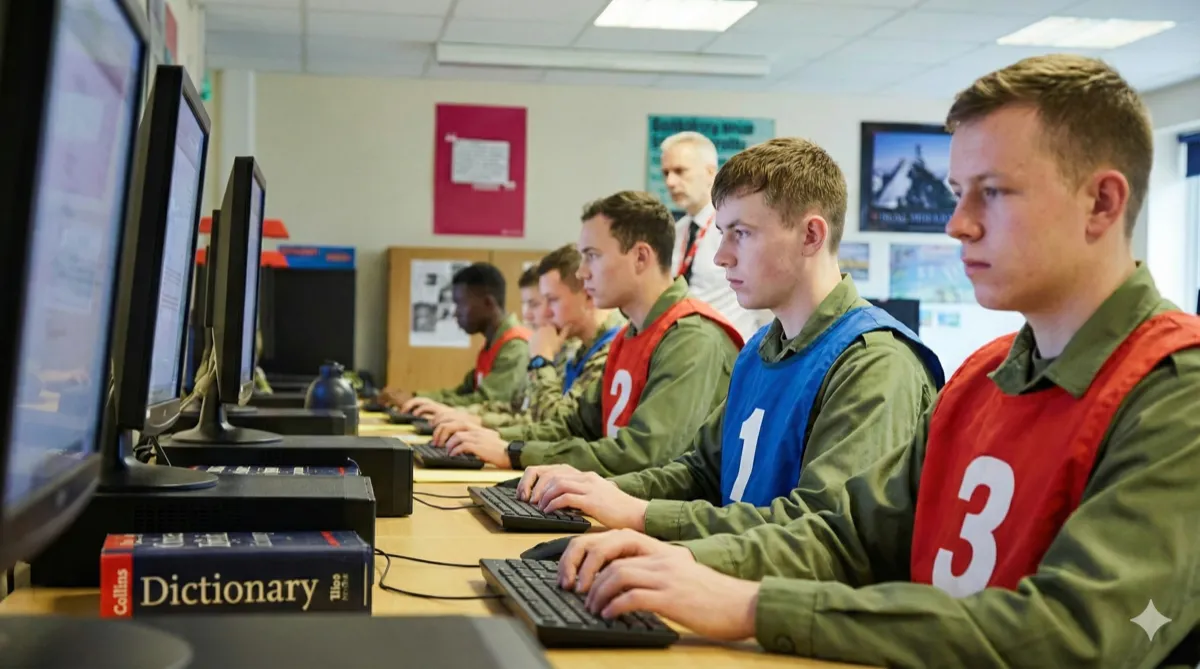
You complete three timed, computer-based psychometric tests covering verbal, numerical, and abstract reasoning. You also undertake a memory & attention (MAT) test and a personality test. These assessments measure your raw intellectual capacity and your ability to solve logical problems under time pressure.
The format and structure of the tests are identical at Briefing and Main Board, so your preparation here serves you twice. Each test rewards a different habit, and the only reliable way to build those habits is to sit practice tests under the real time limits until the pace stops feeling alien.
Prepare for Success
- ✓Simulate Test Conditions: Practice against the clock using questions that are as close as possible to those you will be answering.
- ✓Manage Your Time: If you get stuck, move on and return later. Guessing carries no penalty.
- ✓Use Go-To Strategies: Have a simple method for each question type (e.g., SNAPSS for abstract reasoning).
Group Discussion
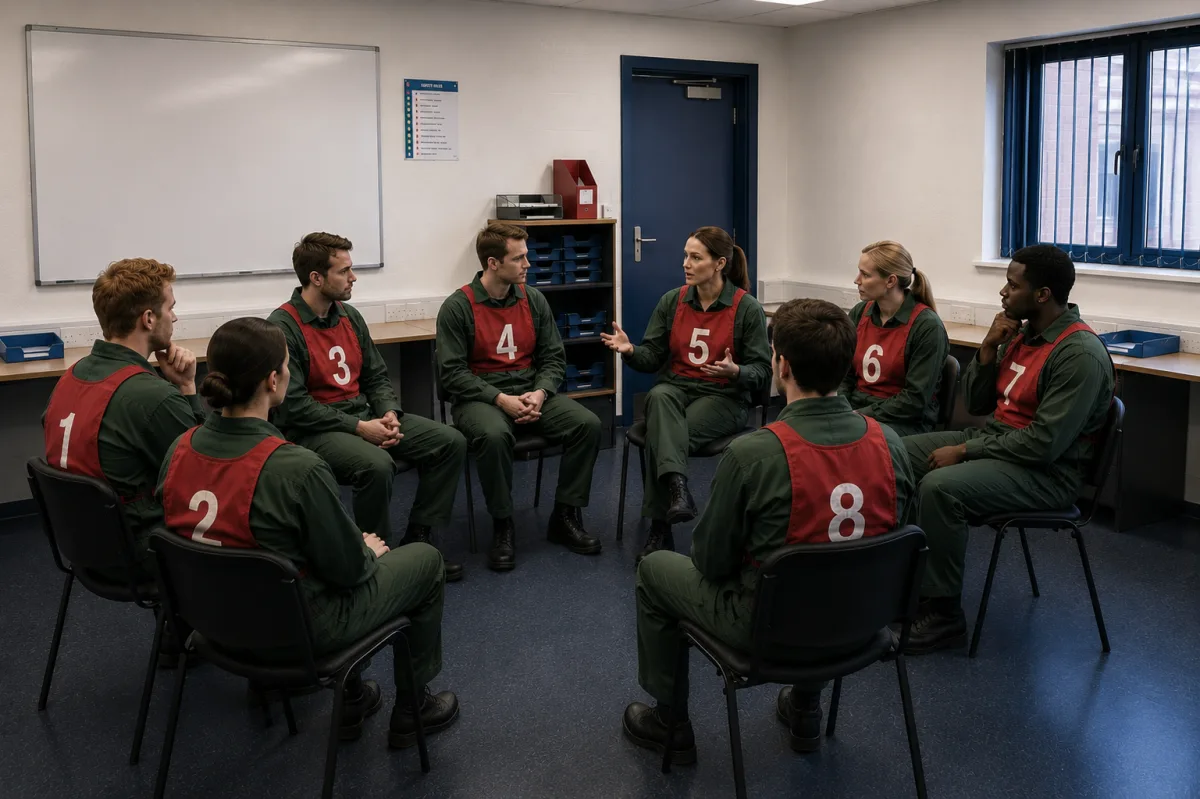
You take part in a thirty-minute discussion with your syndicate on various current affairs topics while assessors observe your engagement and communication. This will be almost identical to the group discussion that you will undertake during Main Board.
Prepare for Success
- ✓Build Awareness Early: Develop an understanding of current affairs through consistent study, as it takes time to develop.
- ✓Practice Makes Perfect: Knowledge alone is not enough. Only with real discussion practice will you become better at articulating what you know clearly.
- ✓Use Concrete Examples: Always support your points with specific references to current events.
Planning Exercise
At Briefing, you receive a tutorial on the planning exercise format before completing an introductory version. You will be given a written scenario involving time and resource constraints and then come up with a plan. This is designed to familiarise you with the process ahead of Main Board, where the exercise is more demanding and carries more pressure.
Prepare for Success
- ✓Master Speed-Distance-Time: Practice answering SDT calculations in a written format, while also getting used to responding to spoken SDT questions.
- ✓Be Familiar with the Format: You complete an exercise soon after the tutorial, so arrive knowing the basics.
- ✓Accept Imperfection: Aim for a plan that is good enough. A perfect plan is almost impossible in the time limit.
Download Your Free AOSB Preparation Guide
Get the complete 34-page guide delivered straight to your inbox.
Interview
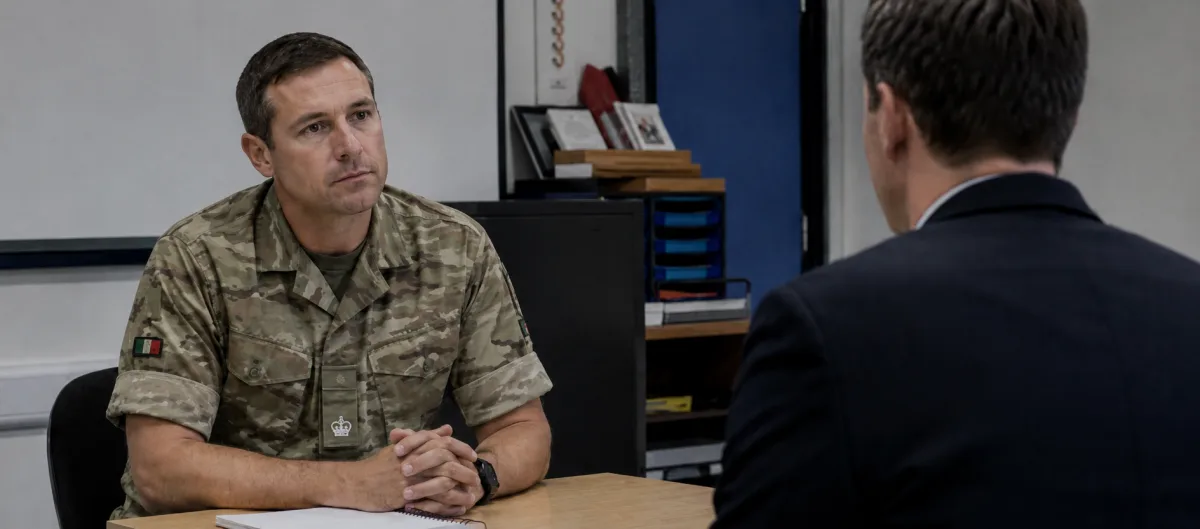
You will attend a short formal interview with a senior Army officer covering your background, leadership potential, and motivation for wanting to become a British Army officer. It typically takes place while your syndicate works through the planning exercise discussion. Each candidate is pulled out in turn for five to ten minutes. The ground it covers is similar to the interviews at Main Board, just in a much shorter format.
Prepare for Success
- ✓Prioritise Authenticity: Natural conviction carries more weight than a polished, rehearsed script.
- ✓Master Etiquette: Use correct titles (Sir/Ma'am) and wait to be seated. Small courtesies matter.
- ✓Use the STAR Technique: Structure your answers using Situation, Task, Action, and Result to provide clear, compelling examples of your experiences.
Day 2
There are no classrooms on day two. Instead, you will head outdoors and engage in more physically demanding activities. The leaderless tasks will assess your ability to problem solve and influence a group without an appointed leader, and the physical tests will assess your current level of fitness. You will then receive your result, before heading home.
Leaderless Task
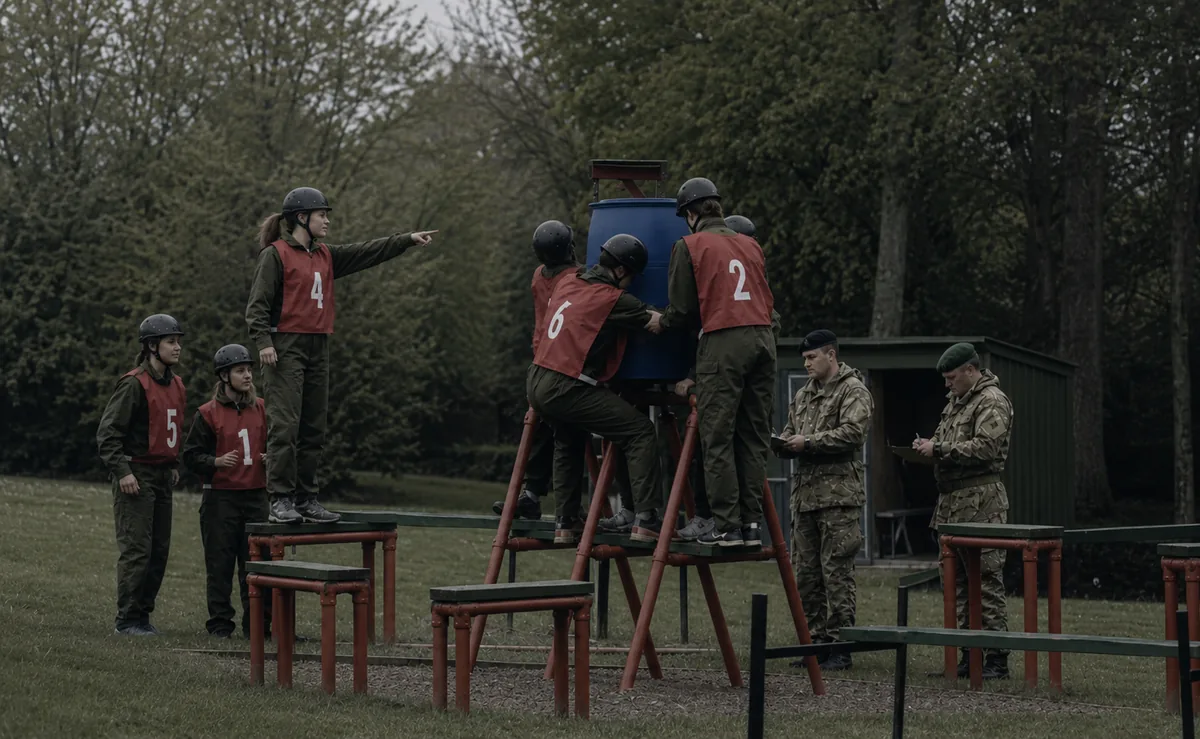
Your syndicate will attempt to solve a series of practical problem-solving challenges on an outdoor obstacle course, involving items such as planks of wood and rope. No leader is appointed. This tests your ability to exert influence over a group without holding a formal role of responsibility, as well as your ability to work as a member of a team.
This also serves as your introduction to the Command Task, which you will face at Main Board. The only real difference is that a leader is formally appointed for the latter; the actual physical challenges you'll solve are almost identical.
Prepare for Success
- ✓Balance Assertion and Collaboration: Influence the group without taking over or becoming overbearing.
- ✓Support Quieter Teammates: Help others contribute rather than sidelining them.
- ✓Maintain Energy Throughout: Keep enthusiasm high from start to finish, especially if the task isn't going to plan.
Physical Assessments
You will complete the Role Fitness Test (Entry), also known as RFT-E, and an obstacle course. These activities assess your functional combat fitness, agility, and determination. You are expected to achieve a minimum of level 7.10 on the bleep test, a 76 kg Mid-Thigh Pull, and a 3.1-metre Seated Medicine Ball Throw.
Prepare for Success
- ✓Start Early: Begin a structured programme as early as possible. Fitness takes time to develop.
- ✓Follow a Balanced Programme: Combine strength, bodyweight exercises, and cardiovascular training consistently.
- ✓Train Beyond the Minimum: The published standards are a baseline, not a target.
Briefing Feedback: Your Most Valuable Resource
At the end of Briefing, you will receive detailed feedback on your performance. This is invaluable. You are being handed a personal development plan by those who know the AOSB process best.
They are telling you exactly what they want to see improved. Take it seriously, and use it to structure your preparation for Main Board. Your feedback should serve as the compass guiding your future preparation. For a complete guide to what awaits you at Main Board, see my definitive guide to AOSB Main Board.
Frequently Asked Questions
What is the Briefing pass rate?
In 2024, 46% of candidates received a Category 1, the result that allows you to proceed directly to Main Board. That is actually lower than the Main Board pass rate of 57%, and only around 26% of candidates who attend Briefing receive a Category 1 and then pass Main Board first time.
How long does Briefing last?
Briefing is a two-day assessment held at the Army Officer Selection Board centre in Westbury. In reality it is a high-intensity 24-hour assessment containing condensed versions of almost all of the assessments you will face at Main Board.
What happens if I get a Category 2 at Briefing?
The board sees potential but wants you to develop in specific areas before Main Board. You will be given a period, typically three months, six months, or longer, to work on the exact areas identified in your feedback. It should be seen positively. The Army wants you at Main Board, just better prepared.
Can I still attend Main Board with a Category 3?
Yes. A Category 3 means the board believes you will struggle at Main Board, but you are still allowed to attend, and once there you compete on a level playing field with everybody else.
Final Thoughts
Briefing marks the point where officer selection becomes serious. Up until now, the process has been relatively straightforward. Briefing is where the Army makes its first real assessment of your potential, and where preparation begins to separate those who progress from those who do not.
The two-day format is intense by design. It needs to be. The Army cannot afford to send candidates to Main Board who are not ready, and it cannot afford to delay those who are. The condensed timeline forces assessors to make quick, accurate judgements about your baseline performance across multiple areas.
Remember that Briefing serves two purposes. It filters, but it also develops. Whether you receive a Category 1 or not, the feedback you receive is your roadmap. Use it. The candidates who succeed at Main Board are not necessarily those who sailed through Briefing with a Category 1. They are those who took their feedback seriously, addressed their weaknesses, and arrived at Main Board genuinely prepared. If this is the career you want, commit to that process from the start.
Ready to Begin Your Prep?
Officer Ready gives you everything you need to arrive at Westbury prepared. Psychometric test practice, planning exercises, and expert guidance from a former British Army officer. Built on the methods the Army uses to develop its own leaders.
Start Preparing