Key Takeaways
In this article I will cover:
- Two Standards: The AOSB minimums make you eligible. Being competitive at Sandhurst is a far higher bar, and it is the one to train for.
- The Day-One Target: A 7:15 2K, 50 push-ups, 12 pull-ups, 70 sit-ups and a 1.5x bodyweight deadlift put you just inside the top third of a 90-cadet company.
- Never Too Fit: Fitness buys clear-headed decision-making, instant credibility with your soldiers and a stronger hand at the RSBs. There is no point where more stops being useful.
- Don't Tab: Loaded marching before Sandhurst is the fastest route to stress fractures. Build the engine and the strength, and let the PTIs handle the rest.
- Arrive Fit: Catching up at Sandhurst is brutal, because everyone around you is improving at once. The work has to happen before you get there.
At some point in your first week at Sandhurst, you will find yourself on the 2K start line alongside every officer cadet in your company. Your legs will feel numb as you wait for the PTI's starting signal. In about ten minutes' time, all 90 of you will be stood in one straight line, in the order that you finished.
Until this point, you will have spent most of your time on the commissioning course completing boring necessities like medical check-ups. But at last you have a chance to prove yourself. Both to the DS and your fellow cadets.
There is far more to being a good officer than a fast 2K, but the Army always has, and always will, place a huge amount of emphasis on your time.
Within a training establishment, the ability to leave others trailing in your wake brings respect like little else. Your position in that line-up matters, probably more than you realise right now.
For most of you, aiming to be first is unrealistic. There is always a freak of nature who gets close to six minutes. But it is well within your control to put in a good showing and finish closer to the front than the back.
So exactly how fit do you need to be for Sandhurst? In this guide I will set out the two standards that matter, the exact numbers to aim for on day one, and how to train towards them.
What Does 'Sandhurst Fit' Actually Mean?
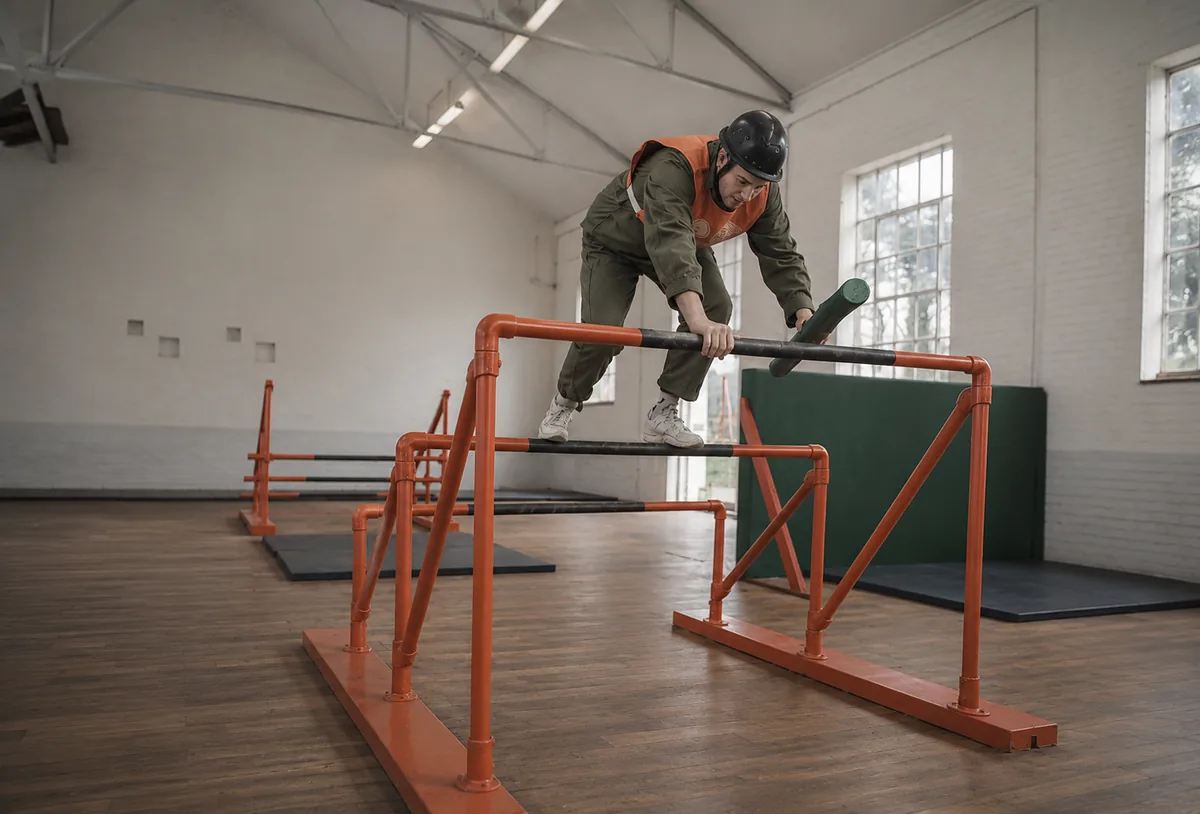
'Sandhurst fit' is broader than most kinds of fitness. It asks for strength, endurance and resilience all at once, and it has to hold up when you are exhausted, freezing and have been going for days on end.
Here are just a few of the physical challenges you will face during the commissioning course:
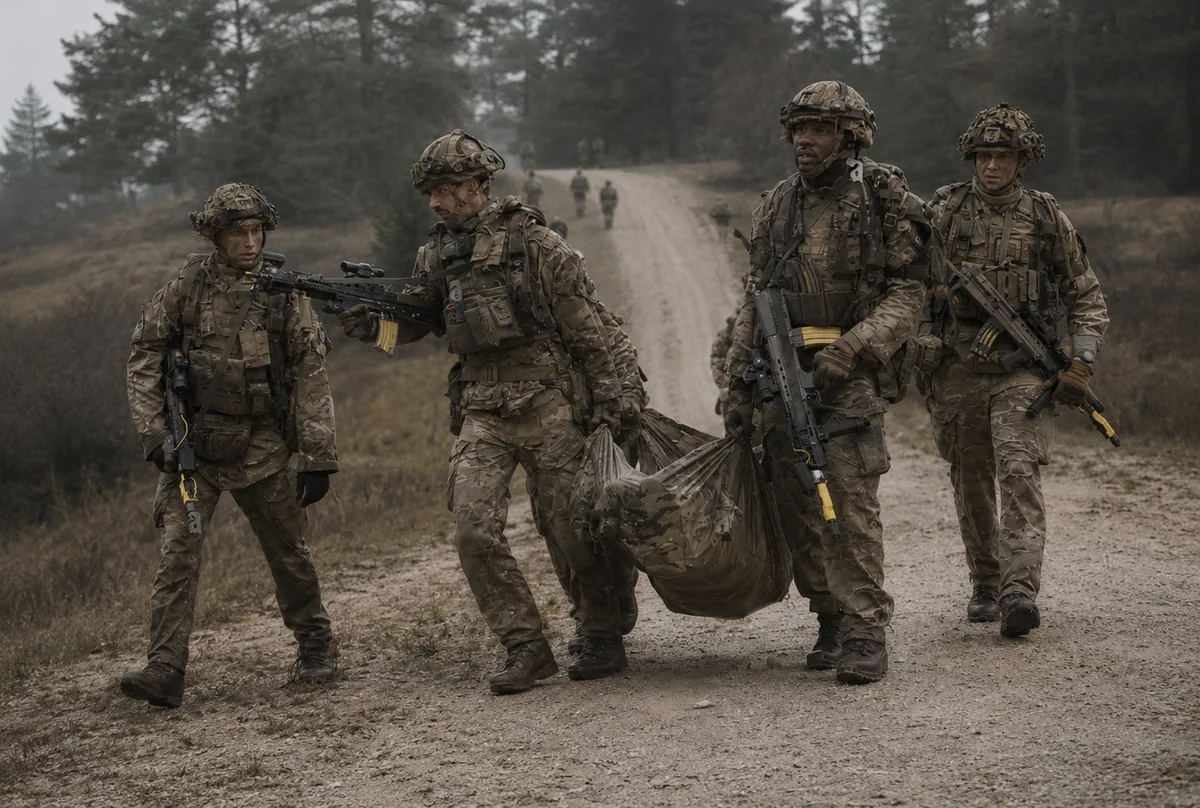
- Carry a 20kg bergen for 36 hours, up and down the Black Mountains in Wales on Exercise Long Reach.
- Fight up a hill by fire and manoeuvre on Barossa Common, down into cover and back up, bound after bound, until the position is taken.
- Tab 10km in the dark with full kit on your back, night after night, for two weeks straight on exercise.
- Dig a battle trench for 24 hours straight on Exercise Slim's Stand, then live and fight out of it.
- Leopard crawl through the Brecon mud while carrying out a section attack.
- Casevac the heaviest man in your platoon a kilometre to safety, four of you sharing the weight, swapping out just before your grip gives out.
Being strong in one area won't make up for a weakness in another. Brilliant cardio alone is not enough, and raw strength without the ability to keep going is not enough. The officer cadets who do best are the ones who arrive both strong and fit.
How Fit Do You Need to Be for Sandhurst?
There are two standards that matter, and the gap between them is wide. The first is the minimum you must hit at AOSB. The second is the level that makes you genuinely competitive once you arrive at Sandhurst, and it is a far higher bar.
The Floor: The AOSB Minimums
The standards below are the AOSB minimums, the bar you must clear to become eligible for selection. They sit alongside everything else you will face at Briefing and Main Board.
Bleep Test
Level 7.10
A shuttle run that gets faster every minute
What It Tests: Aerobic fitness
Mid-Thigh Pull
76kg
A single upward pull against a fixed bar, using the same technique as a deadlift
What It Tests: Explosive strength in your legs, hips and back
Med Ball Throw
3.1m
Throw a 4kg ball as far as you can while seated with your back against a wall
What It Tests: Explosive upper body power
| Test | Standard | Description | What It Tests |
|---|---|---|---|
| Bleep Test | Level 7.10 | A shuttle run that gets faster every minute | Aerobic fitness |
| Mid-Thigh Pull | 76kg | A single upward pull against a fixed bar, using the same technique as a deadlift | Explosive strength in your legs, hips and back |
| Med Ball Throw | 3.1m | Throw a 4kg ball as far as you can while seated with your back against a wall | Explosive upper body power |
Pass these and you are at the minimum required standard for AOSB, but that's about it. The minimums make you eligible. They do not make you competitive, and what follows is a far better guide to the level you should actually be training for.
The Target: The Top Third on Day One
The numbers below are approximately what you need to be just inside the top third for fitness on day one of Sandhurst. By 'just inside the top third' I mean a cadet who would place roughly 30th in a company of 90. The fittest cadets will significantly exceed these standards.
A word of honesty before you read them. These figures come from my own experience of the course rather than any official or published data, so treat them as a well-informed guide rather than a hard rule. Hit them, though, and you will arrive with your fitness firmly on your side.
2K Run
7:15
Best effort over the full 2km
What It Tests: Aerobic fitness
Push-ups
50
Chest just above the floor, then all the way up to straight arms, body kept in a straight line
What It Tests: Chest and shoulder strength and endurance
Deadlift 1RM
1.5x bodyweight
Lifting a loaded barbell from the floor to a standing position
What It Tests: Explosive strength in your legs, hips and back
Pull-ups
12
From a full hang with arms straight, pull until your chin clears the bar, no swinging
What It Tests: Back and biceps strength
Sit-ups
70
Shoulders down to the floor and all the way up on every rep
What It Tests: Core strength and muscular endurance
| Test | Standard | Description | What It Tests |
|---|---|---|---|
| 2K Run | 7:15 | Best effort over the full 2km | Aerobic fitness |
| Push-ups | 50 | Chest just above the floor, then all the way up to straight arms, body kept in a straight line | Chest and shoulder strength and endurance |
| Deadlift 1RM | 1.5x bodyweight | Lifting a loaded barbell from the floor to a standing position | Explosive strength in your legs, hips and back |
| Pull-ups | 12 | From a full hang with arms straight, pull until your chin clears the bar, no swinging | Back and biceps strength |
| Sit-ups | 70 | Shoulders down to the floor and all the way up on every rep | Core strength and muscular endurance |
You will have spotted that these are not the AOSB tests, and that is deliberate. Taken together, the five give a comprehensive snapshot of your fitness. Each one measures a genuine and distinct part of it, so training towards all five leaves no gaps.
They are also easy to test. Almost nobody has a 20-metre course marked out for a bleep test or a 4kg med ball to hand, whereas anyone can go for a run, find a pull-up bar and do push-ups and sit-ups at home. The deadlift is the one exception, though a barbell is far easier to get hold of than a mid-thigh pull bar.
One more thing worth knowing. These are day-one standards, and cadets get fitter as the course goes on. By the start of intermediate term, a 7:05 2K is a better marker of a cadet just touching the top third.
Why You Can Never Be Too Fit
Fitness isn't a switch you either have flicked on or off. It's a sliding spectrum, and there is no point at which more in the tank stops being useful. Here are just some of the reasons why:
- Military leadership and fitness are inseparable. When exhaustion sets in, your decision-making suffers with it. The fitter you are, the longer you hold a clear head while others around you start to lose theirs.
- It makes you competitive at the RSBs. A high level of fitness weighs heavily in your favour when regiments decide who to take. If you are aiming for the teeth arms in particular, it could easily be the difference between a yes and a no.
- It allows you to lead by example. Soldiers will follow an officer who leads from the front, not one who can't keep up.
- Fitness is instant credibility. When you turn up to a unit for the first time, one of the first things your soldiers will judge you on is how fit you are. That is respect you can't fake or talk your way into.
- It proves your self-discipline. Your fitness is one of the few things entirely within your control, and letting it slip is a visible failure of discipline.
- It keeps you off the injury list. The course is built to push you hard, and about 10% of cadets will at some point find themselves in Lucknow Platoon due to injury. The fitter and more resilient you arrive, the less likely that is to be you.
It's true that Sandhurst will work on your fitness, but don't let that tempt you into taking it easy before you get there. If you turn up unfit, catching up is extremely hard. Everyone around you is getting fitter too, so the bar keeps being raised.
Closing the gap means improving at a faster rate than the rest. That is much harder than putting the work in before you arrive.
Download Your Free AOSB Preparation Guide
Get the complete 34-page guide delivered straight to your inbox.
Three Programmes, Three Starting Points
Knowing the standard is one thing. Reaching it takes structured, progressive training, and that is exactly what the fitness programmes inside Officer Ready are built for.
There are three programmes rather than one, because no two people start in the same place. Follow a plan built for someone far fitter than you and you will get injured. Follow one built for a beginner when you are already fit and you will barely move forward.
- Foundation is the entry point, built for anyone returning to training after a long break or starting close to scratch. Four sessions a week, focused on building an aerobic base without breaking your body.
- Develop is the middle tier, for those who already train consistently and have a solid base to build on. Five sessions a week, with a clear step up in volume and intensity.
- Perform is the top tier, for those who are already fit and aiming for the top third at Sandhurst. Six sessions a week, including intervals, threshold runs and hills.
Each programme runs as a four-week block that builds for three weeks, then eases off ahead of a test week. Your scores decide what happens next. You enter your results, train the block and retest, then either move up a tier or go again with new targets.
The progression loop that every programme runs on.
Every session is logged in the Workout Tracker, which tracks your block, your weekly streak and your five test scores against the targets you are set.
The Workout Tracker, as it appears on desktop.The Workout Tracker on desktop, with the mobile view alongside.
It is designed to work just as well in your browser on both your desktop and your mobile, so you can track your workouts, sets and reps as you go, from your phone. That is all the detail I will give here. The full programmes, laid out session by session, are inside the platform.
Frequently Asked Questions
How fit do you need to be for AOSB?
The AOSB minimums are level 7.10 on the bleep test, a 76kg mid-thigh pull and a 3.1m seated med ball throw with a 4kg ball. Clearing them makes you eligible for selection, but they are the floor rather than the target. Sandhurst demands considerably more.
What 2K time should I aim for before Sandhurst?
Aim for 7:15 or quicker. In my experience of the course, that is roughly the time that puts you just inside the top third for fitness on day one, though it comes from observation rather than any official data. The very fittest cadets run close to six minutes.
Should I practise tabbing before Sandhurst?
No. Loaded marching is one of the quickest ways to get injured, and the easiest way to pick up stress fractures in particular. Sandhurst is built for fit civilians rather than conditioned soldiers, so build the engine and the strength beforehand and let the PTIs ease you into tabbing.
Do you need to be able to swim at Sandhurst?
You will sit a swim test on arrival, and there are occasional pool sessions during the course, including treading water and swimming lengths in MTP, which becomes very heavy in the water. If you are not a strong swimmer, spend time getting comfortable in the water before you arrive. It will make those sessions far less punishing.
More Than Fitness
As you train towards these standards, hold one thing in mind. Professional athletes only have to perform when they are rested and ready, and their whole preparation is geared towards peaking in a perfectly controlled environment.
Military training is the opposite. It is about teaching your mind and body to keep going when you have barely slept for days and you are cold, wet and miserable. As a British Army officer, that is exactly when you will be asked not just to keep going, but to lead.
The numbers in this guide only tell half the story. The other half is the quiet confidence that comes from having been pushed far beyond anything you'd done before and knowing you came through it.
That confidence is not something a training plan alone can give you. Every now and then, set yourself a challenge that genuinely frightens you and see it through. For one person that might be a marathon, for another an Ironman.
Do that, and you will arrive at Sandhurst with more than fitness. You will arrive knowing that when things get hard, you keep going.
Ready to Begin Your Prep?
Officer Ready gives you everything you need to arrive at Westbury prepared. Psychometric test practice, planning exercises, and expert guidance from a former British Army officer. Built on the methods the Army uses to develop its own leaders.
View Plans